
Bone Metabolism Related Indexes
Bones are the supporting structures of the human body, which is characterized by hardness and the ability to regenerate and repair. It plays an important role in protecting vital organs and providing the necessary environment for the bone marrow (mainly for blood formation and fat storage), as well as serving as a mineral reservoir for calcium homeostasis and a reservoir for cytokines, and participating in the body's acid-base balance.
Bone is mainly composed of osteoclasts (OC) and osteoblasts (OB), which play an important role in bone metabolism and regulate bone remodeling through direct contact and other interactions. Human bone cells are constantly engaged in cell metabolism, including the interaction between bone cells, and the interaction between red blood cells and stromal cells in the bone marrow for bone remodeling and reconstruction. Under normal circumstances, bone metabolism is carried out according to certain rules, that is, bone homeostasis is formed in the body. Bone homeostasis is regulated by several signaling pathways, such as fibroblast growth factor (FGF), bone morphogenetic protein (BMP), and Wnt signaling pathway (FIG. 1).
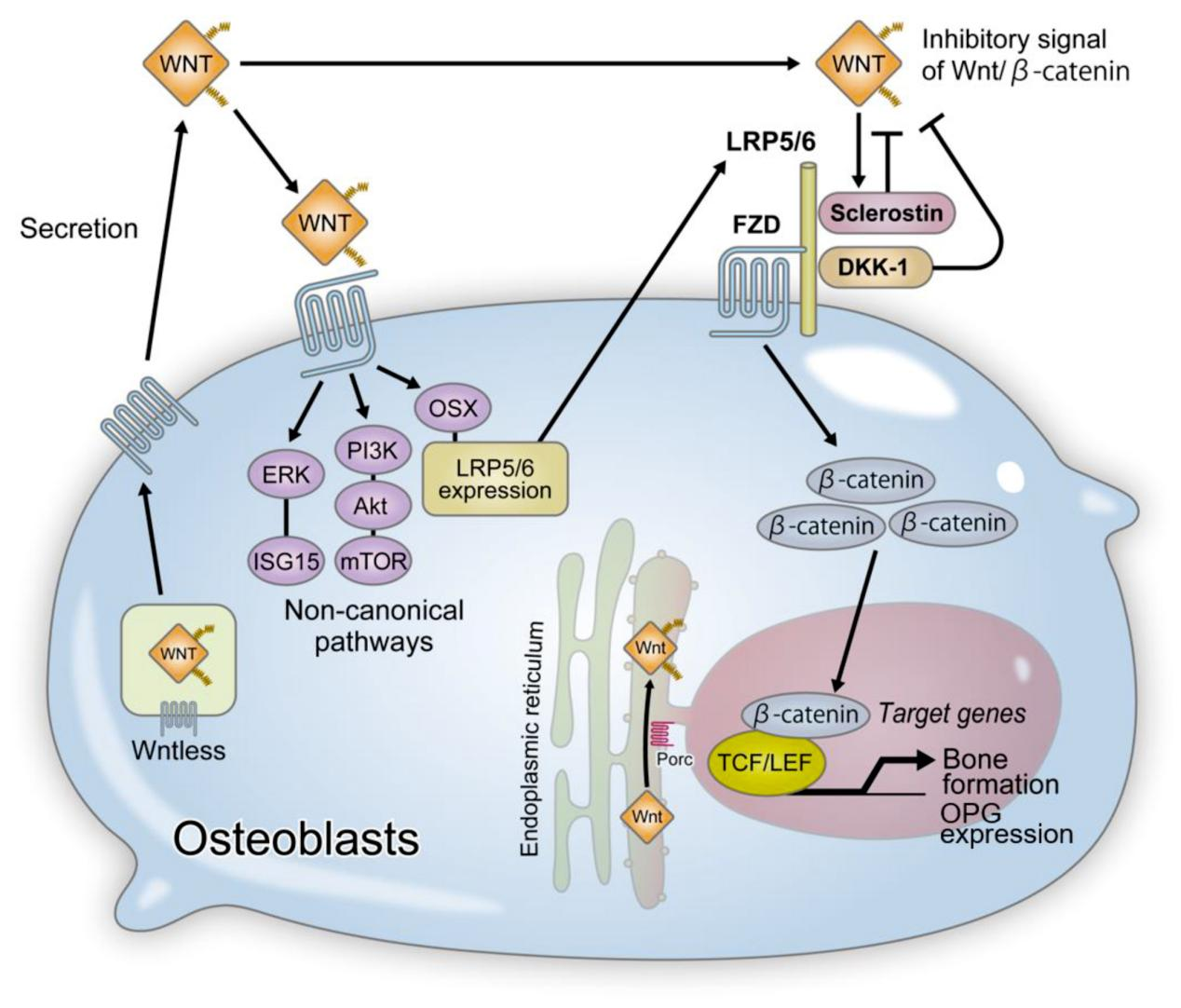
Figure 1. Wnt signaling pathway
However, due to the destruction of human bone homeostasis, it may lead to the occurrence of bone diseases and even lead to cancer. In this process, some relevant targets play an important role. The correlation between representative targets in bone metabolism and bone metabolic diseases is described as follows:
Ⅰ. Targets that reflect bone formation
- Osteocalcin, also known as bone Gla proteins. As a marker of osteoblast cell line, it is involved in the regulation of bone absorption, the process of matrix mineralization and osteoblast differentiation, and is related to bone conversion, can maintain the normal mineralization rate of bone, inhibit the mineralization rate of cartilage, and inhibit the formation of abnormal hydroxyapatite crystals in bone.
The content of osteocalcin in blood reflects the activity of osteoblasts and the condition of bone formation. Some diseases such as osteitis deformans, bone metastases of tumors, hyperthyroidism or hypothyroidism, hyperparathyroidism, Osteoporosis, uremia, rickets, hyperadrenal corticosis, etc., will affect the content of osteocalcin.
- The Carboxyterminal propeptide of type I procollagen (PⅠCP) and Procollagen I Amino Terminal Propeptide (PⅠNP) in blood mainly reflect the active bone turnover and are specific indexes of bone formation. Common associated diseases include metabolic bone diseases, bone tumors, bone metastases, and malformed osteitis.
- Osteoprotegerin (OPG), also known as OCIF and TNFRSF11B, is a secreted TNF superfamily receptor that regulates bone mineral density and can affect bone metabolism. The occurrence of rheumatoid arthritis, ankylosing spondylitis, lung cancer, diabetes, prostate cancer and other diseases can significantly affect the body's blood OPG content.
Ⅱ. Reflect the target of bone resorption
- Tartrate Resistant Acid Phosphatase 5b is a specific index for screening, diagnosis and observation of therapeutic effect in the detection of early primary osteoporosis, and is not susceptible to circadian changes and liver and kidney diseases.
- Cross Linked C-telopeptide of Type Ⅰ Collagen (CTXⅠ) and Cross Linked N-telopeptide of Type Ⅰ Collagen (NTXⅠ), CTX level reflects the bone resorption activity of osteoclasts, serum CTX level can predict the severity of bone turnover, and serve as an important reference index for clinical evaluation of bone change-related diseases. Serum levels of this target in patients with osteoporosis, Paget's disease, multiple myeloma and bone metastases have significant changes compared with healthy subjects.
NTX is a more specific marker for the diagnosis of bone resorption destruction. Serum levels of this target vary significantly in patients with osteoporosis, primary hyperparathyroidism, osteitis deformis, hyperthyroidism, bone metastases and multiple myeloma compared with healthy subjects.
- Osteopontin (OPN) is important in the absorption and mineralization of bone matrix and in maintaining the integrity of bone tissue and surrounding tissues. In diseases such as inflammation, obesity, atherosclerosis, cancer, and tissue damage, this target enhances pathological changes in these diseases.
Ⅲ. The above are the main targets of bone metabolism. Finally, does Reed Bioche Ltd has any products related to the above targets?
Reed Biotech (Wuhan) Ltd. adhere to the customer needs as the core of the market concept, continue to innovate, and pursue excellence, wholeheartedly provide customers with quality services and products. The following is the corresponding product information of the above indexes:
|
Catolog No. |
Detection index |
Species |
Links |
|
RE1766H |
Osteocalcin (OC/BGP) |
Human |
http://www.reedbio.cn/pro/12916 |
|
RE1766M |
Osteocalcin (OC/BGP) |
Mouse |
https://www.reedbio.cn/pro/13327 |
|
RE1766R |
Osteocalcin (OC/BGP) |
Rat |
https://www.reedbio.cn/pro/13643 |
|
RE2751H |
Carboxyterminal propeptide of type 1 procollagen (PⅠCP) |
Human |
https://www.reedbio.cn/pro/12925 |
|
RE2751M |
Carboxyterminal propeptide of type 1 procollagen (PⅠCP) |
Mouse |
https://www.reedbio.cn/pro/13329 |
|
RE2751R |
Carboxyterminal propeptide of type 1 procollagen (PⅠCP) |
Rat |
https://www.reedbio.cn/pro/13624 |
|
RE2875H |
Procollagen I Amino Terminal Propeptide (PⅠNP) |
Human |
https://www.reedbio.cn/pro/12757 |
|
RE2875M |
Procollagen I Amino Terminal Propeptide (PⅠNP) |
Mouse |
https://www.reedbio.cn/pro/13330 |
|
RE2875R |
Procollagen I Amino Terminal Propeptide (PⅠNP) |
Rat |
https://www.reedbio.cn/pro/13106 |
|
RE1765H |
Osteoprotegerin (OPG) |
Human |
https://www.reedbio.cn/pro/12920 |
|
RE1765M |
Osteoprotegerin (OPG) |
Mouse |
https://www.reedbio.cn/pro/13721 |
|
RE1765R |
Osteoprotegerin (OPG) |
Rat |
https://www.reedbio.cn/pro/13621 |
|
RE3058H |
Tartrate Resistant Acid Phosphatase 5b (TRACP-5b) |
Human |
https://www.reedbio.cn/pro/13048 |
|
RE3058M |
Tartrate Resistant Acid Phosphatase 5b(TRACP-5b) |
Mouse |
https://www.reedbio.cn/pro/13383 |
|
RE3058R |
Tartrate Resistant Acid Phosphatase 5b (TRACP-5b) |
Rat |
https://www.reedbio.cn/pro/13671 |
|
RE1463H |
Cross Linked C-telopeptide of Type Ⅰ Collagen (CTXⅠ) |
Human |
https://www.reedbio.cn/pro/12626 |
|
RE1463M |
Cross Linked C-telopeptide of Type Ⅰ Collagen (CTXⅠ) |
Mouse |
https://www.reedbio.cn/pro/13403 |
|
RE1463R |
Cross Linked C-telopeptide of Type Ⅰ Collagen (CTXⅠ) |
Rat |
https://www.reedbio.cn/pro/13092 |
|
RE1464H |
Cross Linked N-telopeptide of Type Ⅰ Collagen (NTXⅠ) |
Human |
https://www.reedbio.cn/pro/12915 |
|
RE1464M |
Cross Linked N-telopeptide of Type Ⅰ Collagen (NTXⅠ) |
Mouse |
https://www.reedbio.cn/pro/13420 |
|
RE1464R |
Cross Linked N-telopeptide of Type Ⅰ Collagen (NTXⅠ) |
Rat |
https://www.reedbio.cn/pro/13105 |
|
RE1770H |
Osteopontin (OPN) |
Human |
https://www.reedbio.cn/pro/12921 |
|
RE1770M |
Osteopontin (OPN) |
Mouse |
https://www.reedbio.cn/pro/13328 |
|
RE1770R |
Osteopontin (OPN) |
Rat |
https://www.reedbio.cn/pro/13622 |
References
[1] Maeda, K.; Kobayashi, Y.; Koide, M.; Uehara, S.; Okamoto, M.; Ishihara, A.; Kayama, T.; Saito, M.; Marumo, K. The Regulation of Bone Metabolism and Disorders by Wnt Signaling. Int. J. Mol. Sci. 2019, 20, 5525. https://doi.org/10.3390/ijms20225525.
[2] Danqi Yao, Lianfang Huang, Jianhao Ke, Ming Zhang, Qin Xiao, Xiao Zhu, Bone metabolism regulation: Implications for the treatment of bone diseases, Biomedicine & Pharmacotherapy, Volume 129, 2020, 110494, ISSN 0753-3322, https://doi.org/10.1016/j.biopha.2020.110494.
- Xiuzhen Zhang, Zhihai Zhang, Hui Xu, etc. Expert consensus on clinical application of biochemical markers of bone metabolism (2020) [J]. Chinese Journal of Osteoporosis, 2020, 26 (6) : 16. DOI: 10.3969 / j.i SSN. 1006-7108.2020.06.001.
[4] Shahi M, Peymani A, Sahmani M. Regulation of Bone Metabolism. Rep Biochem Mol Biol. 2017 Apr; 5(2):73-82. PMID: 28367467; PMCID: PMC5346273.


